As I mentioned earlier, Turner's works do not immediately bring to mind the work of his Romantic contemporaries. Gericault's explicit Raft of the Medusa and Delacroix's frenzied Death of Sardanapalus are both dark--one is shrouded in the shadows of weariness and despair while the other is stained by the blood of passion and pride. Yet, fundamentally, they all mark a return from the refined neoclassicism of Jacques David to works filled with intensity and emotion.
I've always been drawn to paintings that are bold, passionate, and seemingly unrestrained, so it is no wonder that I am drawn to Turner, whose works break free of their canvas constraints and gain a life of their own. What I find most admirable about Turner though, is his ability to win over his audience despite being ahead of his time. I am sure he got away with his abstractions partially because his subjects were seascapes. After all, waves and storms are supposed to be chaotic, their forms everchanging, hard to define and impossible to contain.
While at the BAC, I was even fortunate enough to handle and study a Turner watercolor up close (for a class on connoisseurship). I have to admit though, that I was surprised to find Turner using masking fluids. I know it is a common and legit practice, but somehow (as with knowing about renaissance perspective machines), it dims the level of technical genius I have come to expect from my favorite artists. Of course, I should know better than to hold that romantic view. As much as I'd like to believe in artistic "purity," whether related to authorship, where the artist alone worked on his art, or skills, where the artist paints or draws without the aid of tools, the truth is, sometimes the end more than justify the means. Titan's masterpieces are no less amazing even though they were produced in workshops and Da Vinci is no lesser genius for using the camera obscura to aid his drawings.
Although I like many of Turner's paintings (he painted at least 600 oils), here are a few that wre particularly abstract:
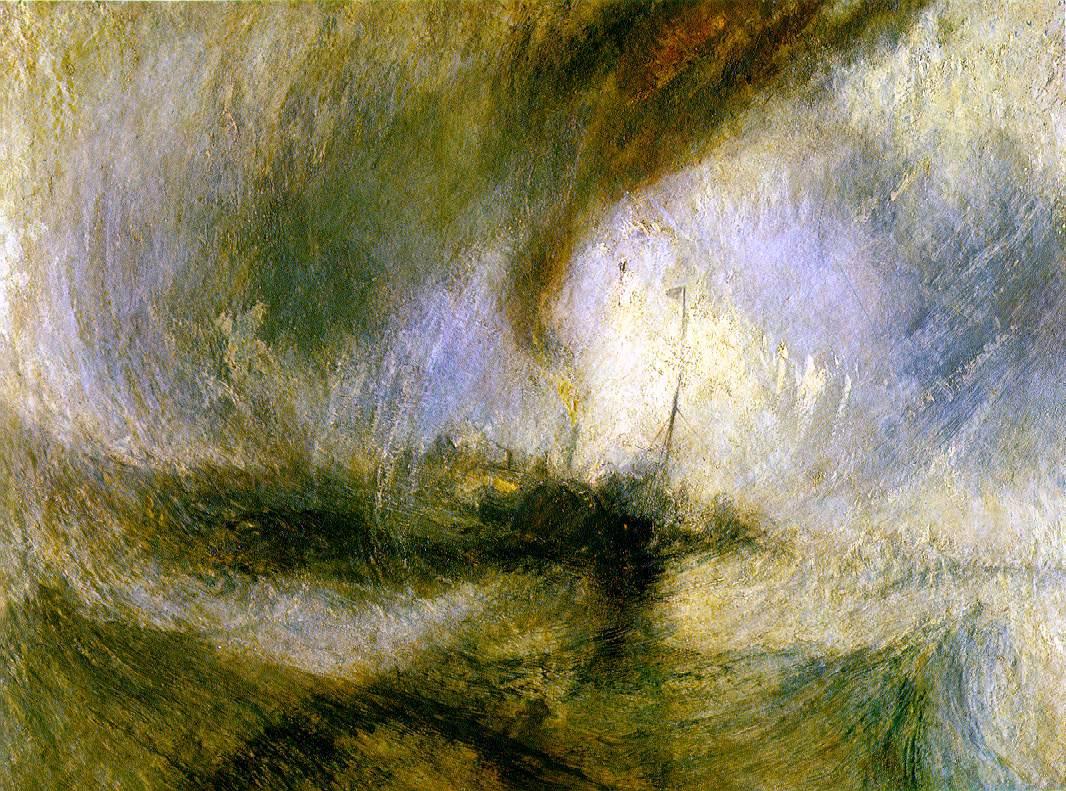 Snowstormteam—Boat off a Harbour's Mouth, John Mallord William Turner, 1842, oil on canvas, 91.5 x 122 cm, Tate, London
 Slave Ship—Slavers Throwing overboard the Dead and Dying—Typhoon coming on, John Mallord William Turner, 1840, oil on canvas, 90.8 x 122.6 cm, Museum of Fine Arts, Boston
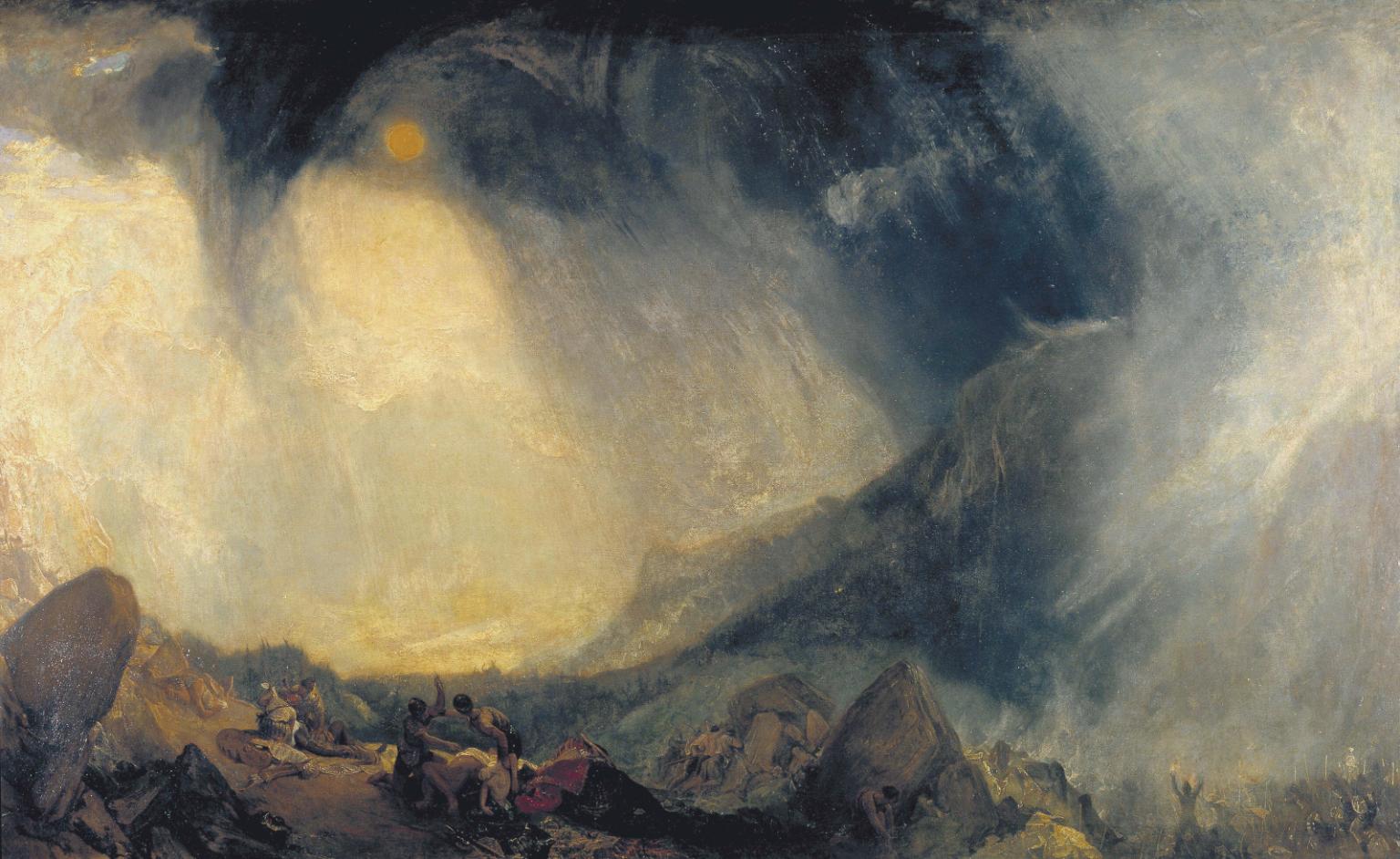 Snow Storm: Hannibal and his Army Crossing the Alps, Joseph Mallord William Turner, 1812, oil on canvas,146 x 237.5 cm, Tate, London

 Posts
Posts


No comments:
Post a Comment