


 There were some more cakes and chocolate liqueur martinis but I think the above was more than enough to make my point.
Link of the day: www.rrrrthats5rs.com/games/dont-shoot-the-puppy
What is it: a very random and quite pointless game, but in a sense, aren't all games ultimately just things that take time and get us to forget a bit of reality? I suppose there are games that teach things as well, but I can't say if people ever approach games with the intent to learn. In any case, this one's quite amusing as it tests your curiosity and constraint.
Artist of the day: Frida Kahlo (1907-1954)
Who is she: a Mexican artist who is perhaps most well known for her surreal self-portraits. She has been the focus of much popular attention, including amovie entitled Frida starring Salma Hayek. Kahlo's turbulent marriage to the famous Mexican muralist Diego Rivera and her numerous affairs easily made her an interesting woman to study.
As I expressed in my post about Pan Yuliang, the personal struggles an artist goes through should not be the sole basis for elevating his or her art. Like Pan, Kahlo's art should not be dwarved by her life, however sensational it may have been. All the same, the pain and sufferings Kahlo went through (including very physical deformations and trauma) are very visible in her works. And somewhat ironically, I like her paintings precisely because she so clearly articulated her feelings through surrealistic means, a genre most often associated with a sense of detachment (the dreamscapes of Dali, Chirico, and Margritte, even when they deal with the grotesque, generally portray things through a veil of perplexing relationships). While Kahlo also used dreamlike logic in her art, the combination of objects she chose often elicits very visceral reactions and makes her paintings much more proactive and intense - Kahlo reaches through the protective film surrealistic works often lend their subjects to connect viewers to her pain.
In this way, Kahlo's experiences contributed to the greatness of her art. Am I being hypocritical? I don't know and I hope not. There is a fine line between valuing artworks shaped by the unique experiences of their creators and elevating art of interesting artists. I feel like art historians constantly juggle with these concepts as they analyze works of art. Should they focus more on theory, biography, aesthetics, or history? I don't think there is a clear answer but I would like to think it is a balance of both context and content. Great art should be able to stand on its own artistic merits and at the same time, offer insights when its background (artist, time period, intent, etc.) is revealed.
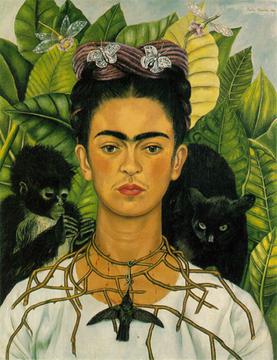 Self-portrait with Thorn Necklace and Hummingbird, Frida Kahlo, Nikolas Muray Collection, Harry Ransom Center, The University of Texas at Austin

 Posts
Posts


2 comments:
I was going to respond, but looking at those chocolate pictures made me lose consciousness.
no you ate the all six plates of food, remember?
Post a Comment