I am being worked Monday - Sunday from 9 until at times 4 am, so I have little time to update. I keep thinking the break is coming. It won't until after February. Sorry to everyone who actually follows this blog. Good news is I have been collecting lots of materials, so expect a bountiful rebound :)
For now, everyone should check out:
http://www.coraline.com/
Very nicely designed site (even for film debut standards).
Thursday, January 29, 2009

Monday, January 5, 2009
Red, Yellow, and Blue
My parents are re-doing my room now that I no longer live at home. One of their great ideas is to make my bed fold into a giant closet that will take up an entire wall of my bedroom. While looking over the blueprints for the closet design, I thought the doors looked like Mondrian's squares so I pitched the idea that they make the entire closet model after one of Mondrian's paintings. The idea went well with my dad (he has plenty of “gaudy” art deco primary colored objects), but apparently my mom is equally enthused with the idea.
This naturally reminds me of the time I visited the Ludwig Museum in Cologne last year around this time. They had a very impressive and comprehensive exhibit of the artist. I will cover more of that in detail later, but while searching for Mondrian through the web, I found the following Nike shoes. Rather interesting, no?
 Nike Dunk Low Premium SB, image from freshnessmag.com
This naturally reminds me of the time I visited the Ludwig Museum in Cologne last year around this time. They had a very impressive and comprehensive exhibit of the artist. I will cover more of that in detail later, but while searching for Mondrian through the web, I found the following Nike shoes. Rather interesting, no?
 Nike Dunk Low Premium SB, image from freshnessmag.com
Piet Mondrian (1872-1944)
Piet Mondrian is a Dutch painter most well-known for his grid-like paintings with their boxes of black, white, red, blue, and yellow, although his palette is not limited to the primary colors. As mentioned in my Red, Yellow, and Blue post, I was fortunate enough to visit the Ludwig Museum of Cologne in December, 2007 and saw Mondrian, one of the largest exhibits of the Dutch artist's works. The paintings are displayed in chronological order and invites viewers to see for themselves how Mondrian developed and matured as an artist. I walked away particularly moved by some of his earlier landscapes.
 Duinlandschap (Dune Landscape), Piet Mondriaan, 1911, oil on canvas, 141 x 239 cm, Collection Gemeentemuseum Den Haag
 Evening; Red Tree, Piet Mondriaan, 1908, oil on canvas, 25.5 x 39 cm, Collection Gemeentemuseum Den Haag
Veoh has a great video of the exhibit, including excellent shots of some select works.
I have always been told that Mondrian's rectangles and proportions follow golden ratios. I have not had the time to dig more into the truth of the matter (once I find out, I will definitely update), but I still think his compositions are well-balanced.
The collection is actually in the keeping of the Gemeentemuseum in The Hague, so if anyone is in the area, be sure to check it out!
 Duinlandschap (Dune Landscape), Piet Mondriaan, 1911, oil on canvas, 141 x 239 cm, Collection Gemeentemuseum Den HaagEvening; Red Tree, Piet Mondriaan, 1908, oil on canvas, 25.5 x 39 cm, Collection Gemeentemuseum Den Haag
Veoh has a great video of the exhibit, including excellent shots of some select works.
I have always been told that Mondrian's rectangles and proportions follow golden ratios. I have not had the time to dig more into the truth of the matter (once I find out, I will definitely update), but I still think his compositions are well-balanced.
The collection is actually in the keeping of the Gemeentemuseum in The Hague, so if anyone is in the area, be sure to check it out!
Sunday, January 4, 2009
Site: www.gutenberg.org
Project Gutenberg is a website dedicated to making classical literature available on the internet. I actually came across this site quite a while ago when looking for works on Arsene Lupine. For all you Ocean 11, To Catch a Thief, and MI lovers out there, he was a classy thief and disguise extraordinaire way before movies popularized Clooney, Grant, and Cruise. Japanese anime, which is quick to reference and adapt interesting things from other parts of the world (including, for example, Sun Tzu’s furinkazan), even has an animation called Lupin the Third.
In any case, I was pleasantly surprised when I came across the site again while looking for an online version of Art of War. Even though occasionally I am nostalgic about the “old days,” when people actually spend more times moving about than sitting in front of a computer screen, at times like these I am grateful for the internet and how it has spread knowledge and news across the globe. I wonder if, when the printing press first came out, people were nostalgic about the oral tradition?
In any case, I was pleasantly surprised when I came across the site again while looking for an online version of Art of War. Even though occasionally I am nostalgic about the “old days,” when people actually spend more times moving about than sitting in front of a computer screen, at times like these I am grateful for the internet and how it has spread knowledge and news across the globe. I wonder if, when the printing press first came out, people were nostalgic about the oral tradition?
Furinkazan
In Japanese, "furinkazan" means "wind, forest, fire, mountain." Like Chinese proverbs, the whole in this case is much greater than the sum of its parts. Furinkazan actually refers to the motto painted on the battle standards of Takeda Shingen, a Sengoku period daimyo who quoted (partially) Sun Tzu's Art of War when he decided to focus on the first four of Sun Tzu's maneuver recommendations:
"Swift like the wind"
"Silent like a forest"
"Aggressive like fire"
"Unmovable like a mountain"
"Mysterious like a shadow"
"Move like a trembling of a thunder"
Quite the nice imagery, no? I have to admit, when I first started this post I was going somewhere with it, but now I don't remember why anymore. Woe to me for not updating more often :( In any case, I think this goes very well with my posts with Japanese themes (i.e. my post on Hokusai and Project Gutenberg)
"Swift like the wind"
"Silent like a forest"
"Aggressive like fire"
"Unmovable like a mountain"
"Mysterious like a shadow"
"Move like a trembling of a thunder"
Quite the nice imagery, no? I have to admit, when I first started this post I was going somewhere with it, but now I don't remember why anymore. Woe to me for not updating more often :( In any case, I think this goes very well with my posts with Japanese themes (i.e. my post on Hokusai and Project Gutenberg)
Saturday, January 3, 2009
Happy New Year
Although I've been rather negligent with my posts for the last two months, I will by no means stop trying :) I've discovered that often, I hesitate to post because I could not conduct the research for my artist posts with images in time. However, that should not stop me from posting other interesting tidbits of news. Hence, I've decided from now on to split up my different types of posts. Musings on artists will have their names as titles while posts on interesting sites will have "Site" as part of their titles.
On the last day of 2008, I attended the Art and Empire: Treasures from Assyria from the British Museum exhibit at the Museum of Fine Arts in Boston. I had just finished reading about Assyria in Gods, Graves, and Scholars not too long ago, so the exhibit was extremely timely. Although the famous Dying Lioness was not on view, the exhibit does showcase a marvelous series of reliefs depicting one of Ashurbanipal's lion hunts. The exhibit is definitely worth a visit, with a good range of objects from reliefs, seals, pottery, to little clay tablets.
On the last day of 2008, I attended the Art and Empire: Treasures from Assyria from the British Museum exhibit at the Museum of Fine Arts in Boston. I had just finished reading about Assyria in Gods, Graves, and Scholars not too long ago, so the exhibit was extremely timely. Although the famous Dying Lioness was not on view, the exhibit does showcase a marvelous series of reliefs depicting one of Ashurbanipal's lion hunts. The exhibit is definitely worth a visit, with a good range of objects from reliefs, seals, pottery, to little clay tablets.
Katsushika Hokusai (1760–1849)
Hokusai is an eccentric Japanese artist whose works have become truly iconic. I am sure everyone has seen the wave, and a good few has seen his red Fuji. Well, both are prints in 36 Views of Mount Fuji by the Japanese artist Hokusai. I first encountered his works in a junior high language arts class, where I read a short story about the artist's rather peculiar life - everything from how his works were once bought and used as wrapping paper to how he made a chicken walk in red ink and then across a scroll to depict maple leaves.
His interesting and creative character aside, Hokusai's art is truly beautiful in their linear design and use of color. A brief bit of research will reveal the magnitude of his contributions to art for both Japan and the rest of the world. Hokusai was not only a leading expert of Chinese art Japan, but had studied Western art (primarily perspectives of Dutch etchings) as well. My understanding of Japanese history is limited, but I should think it is quite revolutionary for Hokusai to study foreign techniques in Edo Japan, a country that pursued a policy of isolation for more than 200 years (it was not until 1854 that Matthew Perry "opened up" the land of the rising sun).
Hokusai's training in Chinese and Western techniques heavily influenced his art, and consequently, Japanese woodblock and ukiyo-e. As much as his works left lasting impressions in Japan - he even coined the term "manga" - Hokusai may have had more impact in the West, where his prints (along with the prints of other Japanese masters) became inspiration and case studies for impressionists like Monet. The rest, as they all say, is history.
As with most of my blog posts, it is impossible in so few words to even scratch the surface of Hokusai, a man who changed his name five times officially and moved at least 90 times. Just google around and one can find countless articles and academic papers on him. What I like most about Hokusai, aside from looking at his prints (and occasionally "borrowing" them to use as backgrounds in my drawings), is reading about him. He is just so much fun to learn about!
 Carp Leaping a Cascade, Katsushika Hokusai, print, 19th century
 Phoenix, Katsushika Hokusai, 19th century
Perhaps a better known phoenix image is housed in the Museum of Fine Arts, Boston. I was fortunate enough to attend Drama and Desire: Japanese Paintings from the Floating World 1690–1850, and saw the screen in person, not to mention a marvelous painting of Zhongkui by Hokusai.
 excerpt from Hokusai Manga, Katsushika Hokusai, 19th century, image from James A. Michener's Hokusai Sketchbooks: Selections from the Manga (1958)
As is evident by the sketches in the above image, Hokusai is probably a man of humor as well.
His interesting and creative character aside, Hokusai's art is truly beautiful in their linear design and use of color. A brief bit of research will reveal the magnitude of his contributions to art for both Japan and the rest of the world. Hokusai was not only a leading expert of Chinese art Japan, but had studied Western art (primarily perspectives of Dutch etchings) as well. My understanding of Japanese history is limited, but I should think it is quite revolutionary for Hokusai to study foreign techniques in Edo Japan, a country that pursued a policy of isolation for more than 200 years (it was not until 1854 that Matthew Perry "opened up" the land of the rising sun).
Hokusai's training in Chinese and Western techniques heavily influenced his art, and consequently, Japanese woodblock and ukiyo-e. As much as his works left lasting impressions in Japan - he even coined the term "manga" - Hokusai may have had more impact in the West, where his prints (along with the prints of other Japanese masters) became inspiration and case studies for impressionists like Monet. The rest, as they all say, is history.
As with most of my blog posts, it is impossible in so few words to even scratch the surface of Hokusai, a man who changed his name five times officially and moved at least 90 times. Just google around and one can find countless articles and academic papers on him. What I like most about Hokusai, aside from looking at his prints (and occasionally "borrowing" them to use as backgrounds in my drawings), is reading about him. He is just so much fun to learn about!
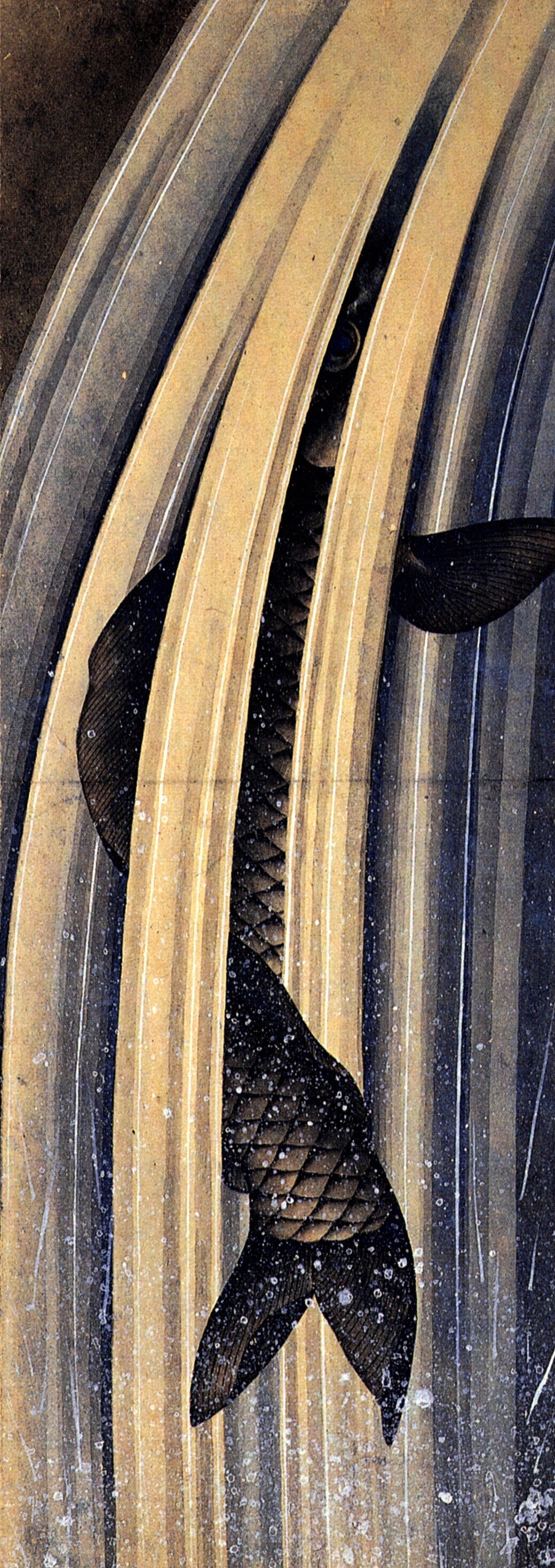 Carp Leaping a Cascade, Katsushika Hokusai, print, 19th century
 Phoenix, Katsushika Hokusai, 19th century
Perhaps a better known phoenix image is housed in the Museum of Fine Arts, Boston. I was fortunate enough to attend Drama and Desire: Japanese Paintings from the Floating World 1690–1850, and saw the screen in person, not to mention a marvelous painting of Zhongkui by Hokusai.
 excerpt from Hokusai Manga, Katsushika Hokusai, 19th century, image from James A. Michener's Hokusai Sketchbooks: Selections from the Manga (1958)
 As is evident by the sketches in the above image, Hokusai is probably a man of humor as well.
Subscribe to:
Comments (Atom)

 Posts
Posts


