Last year around this time, I was walking through the Harvard Yard and taking pictures of trees by lamplight when I noticed a sticker on one of the lamps. I thought it was interesting that someone would go through so much trouble to tag a lamp so high up but did not investigate further. Yesterday, while browsing through the Times, I came upon a slide show for the movie, Art by Losers. I was pleasantly surprised by the images of Shepard Fairey's Obey posters. One of them happen to feature that sticker design I chanced upon more than a year ago. Doing some research led me to a good number of sites about the artist.
Link of the day: obeygiant.com
What is it: Fairey's official site on the Obey family merchandise and news. While there are a good number of fan sites available, I like the site design here even if it is very commercial. At least you can still download free templates and images for printing your own Obey stickers and stencils. A more comprehensive image database of Fairey's works can be found at thegiant.org.
Artist of the day: Shepard Fairey
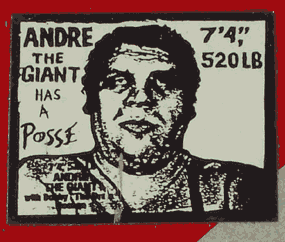
Who is he: a contemporary artist most well know for his sticker campaign series that featured Andre the giant, who, by the way, played Fezzik in one of my all time favorite movies, the Princess Bride. The campaign started as a joke when Fairey was just a RISD student in the late 80's to early 90's. He created an Andre the giant has a posse sticker and placed it all over Providence "as a way to be mischievous and also [to] put something out in the world anonymously" he could call his own. It certainly sparked interest in the public and Fairey started posting them in Boston and New York. He also spread the stickers among friends and the project took off from there. The stickers number millions now and have been featured in countless movies and TV shows, including Batman and Family Guy. Although the original sticker image has been modified (possibly due to a lawsuit from Andre and his posse), the stylized version remains popular.
As Fairey expressed in his 1990 manifesto, his sticker campaign was an experiment in phenomenology, or the study of our awareness / consciousness of our experiences (in this case visual). My definition of phenomenology is fuzzy at best but I am sure readers of Heidegger and Husserl can shed more light on what it encompasses. In any case, from my understanding of Fairey's manifesto, it appears that the first aim of the stickers was to cause people to react. As Fairey put it, "Because people are not used to seeing advertisements or propaganda for which the product or motive is not obvious, frequent and novel encounters with the sticker provoke thought and possible frustration, nevertheless revitalizing the viewer's perception and attention to detail."
Upon reflection though, I wonder if this isn't an aim for most art that requires viewer interpretation. This is especially true for untitled pieces where the artist usually give the viewer no clue as their intentions. Instead, we are left to search for ourselves and through our interpretations reveal our own sensibilities and states of mind. I also highly doubt that the campaign is still a study in phenomenology, especially after Shepard's rise to fame and his most recent images of Obama. Can one really divorce meaning from images if the images are of current contentious issues or public (and political) figures?

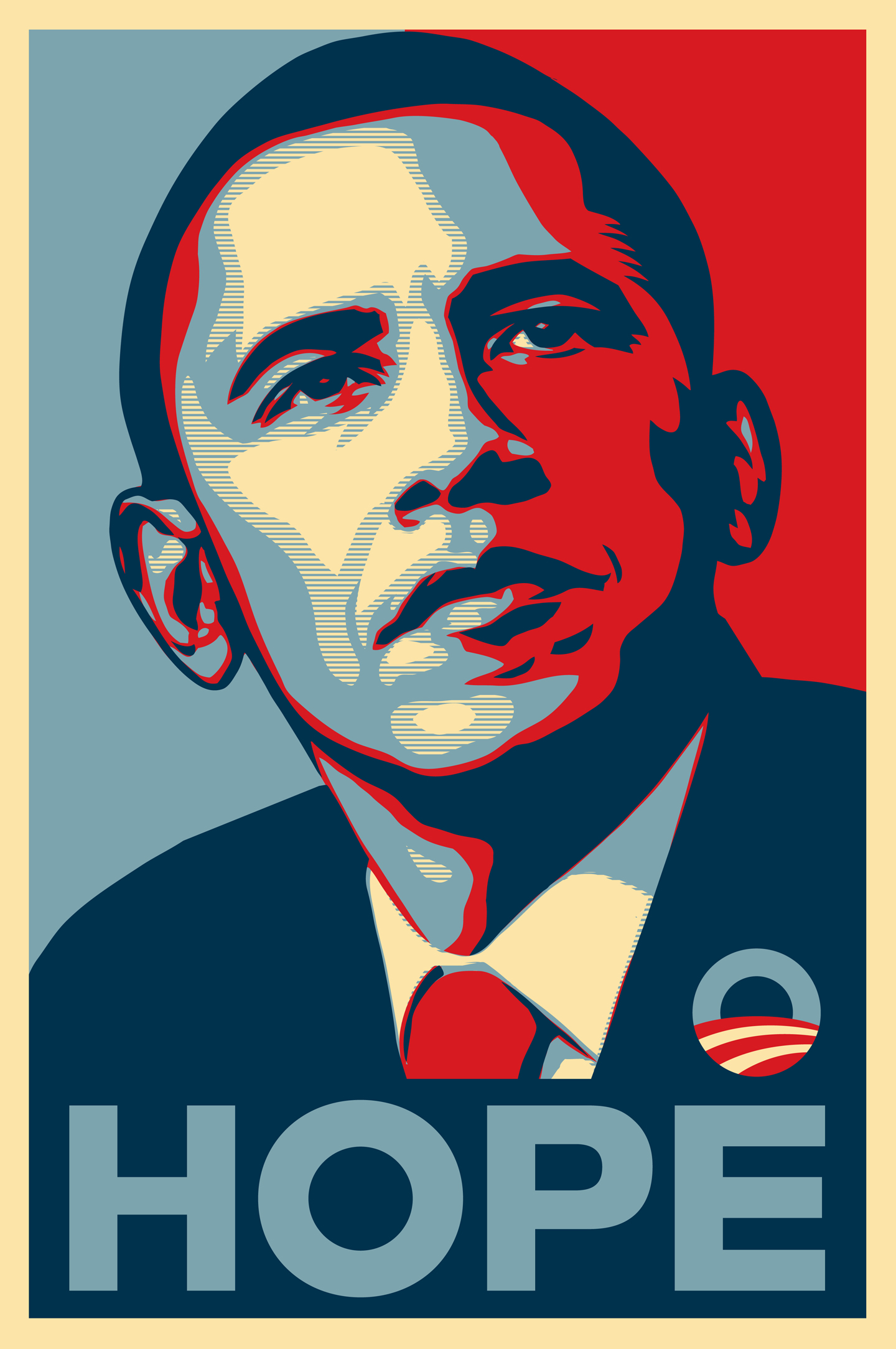 One of Shepard's more recent and visible works, image from obeygiant.com






 Posts
Posts